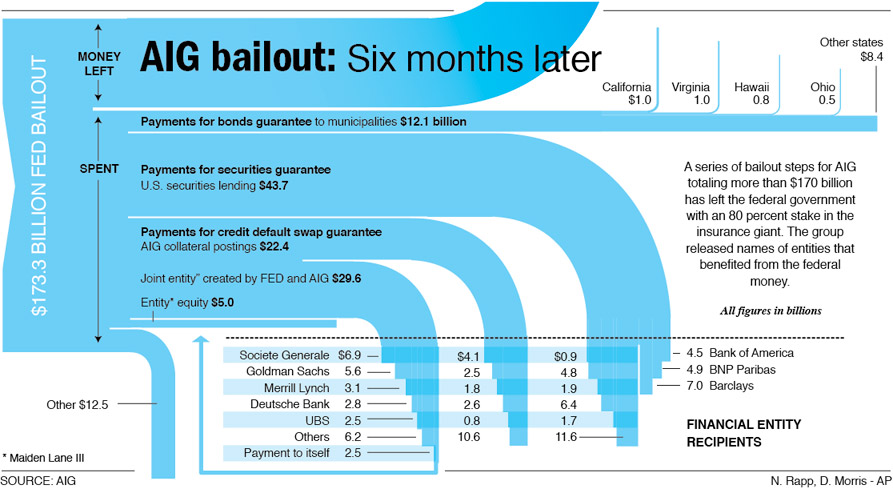
Wicked cool infographic:
>
via Nicholas Rapp
>
Hat tip FlowingData
Source:
Six months after the AIG bailout: Where is the money?
Information Design, March 16th, 2009
http://nicolasrapp.com/?p=347


Stress Test, Quarterly Forecasts for Unemployment and GDP
Earlier I posted the publicly released economic scenarios from the Supervisory Capital Assessment Program (bank stress tests).
The following graphs shows the stress test economic scenarios on a quarterly basis as provided by the regulators to the banks as part of the FAQs (no link). I've also added the most recent forecasts from Paul Kasriel at Northern Trust, and from Goldman Sachs (no link) for comparison.
The first graph is for the unemployment rate through 2010. This is a quarterly forecast - the January unemployment rate was 7.6% and February 8.1%.
 Click on graph for larger image in new window.
Although the two private forecasts don't include all of 2010, it appears that both the Kasriel and Goldman forecasts are near the "more adverse" scenario for 2009.
The second graph makes the same comparison for changes in real GDP.
 An interesting note: the stress test scenario is using the advanced GDP release estimate for Q4 2008 of -3.8%, as opposed to the revised estimate of -6.2%.
 Once again the private forecasts are tracking much closer to the the more adverse scenario than the baseline scenario.
And please don't think Kasriel and Goldman are UberBears. From Paul Kasriel: Light at the End of the Tunnel or an Oncoming Freight Train?
With regard to the economy, we believe there are faint signs of light at the end of the tunnel. Real consumer spending increased by 0.4% in January (and is likely to be revised up) and the decline in February nominal retail sales of 0.1% suggests that the decline in real consumer spending that month will not be severe. For the first quarter as a whole, we now expect a contraction in consumer spending much less severe than last year’s fourth-quarter contraction of 4.3%. Although we do not expect to see outright growth in real consumer spending until the fourth quarter of this year, we believe the deepest quarterly contraction is behind us. With light motor vehicle sales idling just above 9 million units at an annual rate, it appears that for the first time since 1945 there are more used cars and trucks being scrapped than there are new ones getting out on the highways. At some point in the not-too-distant future, the purchases and production of cars and trucks will be stepped up.These are the points I've been making and I also think there is a good chance (better than a coin flip) that GDP will turn slightly positive later this year. However I also think any recovery will be very sluggish.
Even with these "faint signs of light at the end of the tunnel", it appears the "more adverse" scenario is now the real baseline.


Bank Failure #18: FDIC Closes FirstCity Bank, Stockbridge, Georgia
From the FDIC: FDIC Approves the Payout of Insured Deposits of FirstCity Bank, Stockbridge, Georgia
The Federal Deposit Insurance Corporation (FDIC) approved the payout of the insured deposits of FirstCity Bank, Stockbridge, Georgia. The bank was closed today by the Georgia Department of Banking and Finance, which appointed the FDIC as receiver.It feels like Friday ...
...
As of March 18, 2009, FirstCity had total assets of $297 million and total deposits of $278 million. At the time of closing, the bank had approximately $778,000 in deposits that exceeded the insurance limits. This amount is an estimate that is likely to change once the FDIC obtains additional information from these customers.
...
The FDIC estimates the cost of the failure to its Deposit Insurance Fund to be approximately $100 million. FirstCity Bank is the eighteenth FDIC-insured institution to fail this year. The last bank to fail in Georgia was Freedom Bank of Georgia, Commerce, on March 6, 2009.


WAMU Sues FDIC for $6.5 Billion
Now ain’t this a bitch?
Washington Mutual’s holding company is suing federal regulators for billions of dollars, saying the firesale of the bank’s assets to JPMorgan Chase violated its rights. The lawsuit was filed Friday in federal court against the Federal Deposit Insurance Corp., which seized the Seattle-based savings and loan in September. It was the largest bank failure in U.S. history.
Lawyers for the holding company, Washington Mutual Inc., argue that the bank was worth more than the $1.9 billion JPMorgan paid for it in a deal arranged by the FDIC. The lawsuit argues that if WaMu’s assets had been liquidated prudently, they would have been worth more than that.
An FDIC spokesman did not immediately return a call seeking comment Saturday.
At what point do you just liquidate every last one of these sons of bitches — and throw their management in jail?
>
Sources:
Washington Mutual sues FDIC for over $13 billion
Reuters, Sat Mar 21, 2009 1:49pm EDT
http://www.reuters.com/article/newsOne/idUSTRE52K1K620090321
WaMu holding company sues FDIC over bank seizure
AP, Sat Mar 21, 7:05 pm ET
http://news.yahoo.com/s/ap/20090321/ap_on_bi_ge/wamu_lawsuit


BF 19 & 20: FDIC Seizes Teambank, National Association, Paola, Kansas and Colorado National Bank, Colorado Springs, Colorado
From the FDIC: Herring Bank, Amarillo, Texas, Assumes All of the Deposits of Colorado National Bank, Colorado Springs, Colorado
Colorado National Bank, Colorado Springs, Colorado, was closed today by the Office of the Comptroller of the Currency, which appointed the Federal Deposit Insurance Corporation (FDIC) as receiver. To protect the depositors, the FDIC entered into a purchase and assumption agreement with Herring Bank, Amarillo, Texas, to assume all of the deposits of Colorado National.From the FDIC: Great Southern Bank, Springfield, Missouri, Assumes All of the Deposits of Teambank, National Association, Paola, Kansas
...
The FDIC estimates that the cost to the Deposit Insurance Fund will be $9 million. Herring Bank's acquisition of all the deposits was the "least costly" resolution for the FDIC's Deposit Insurance Fund compared to alternatives. Colorado National is the nineteenth FDIC-insured institution to fail in the nation this year and the first in the state. The last FDIC-insured institution closed in Colorado was BestBank, Boulder, on July 23, 1998.
Teambank, National Association, Paola, Kansas, was closed today by the Office of the Comptroller of the Currency, which appointed the Federal Deposit Insurance Corporation (FDIC) as receiver. To protect the depositors, the FDIC entered into a purchase and assumption agreement with Great Southern Bank, Springfield, Missouri, to assume all of the deposits of Teambank.That makes three today (the Corporate Credit Unions are different, but probably a bigger story).
...
The FDIC estimates that the cost to the Deposit Insurance Fund will be $98 million. Great Southern Bank's acquisition of all the deposits was the "least costly" resolution for the FDIC's Deposit Insurance Fund compared to alternatives. Teambank is the twentieth FDIC-insured institution to fail in the nation this year and the first in the state. The last FDIC-insured institution closed in Kansas was The Columbian Bank and Trust Company, Topeka, on August 22, 2008.
Teambank was affiliated with Colorado National Bank, Colorado Springs, which was also closed today by the Office of the Comptroller of the Currency. The FDIC entered into a separate transaction with Herring Bank, Amarillo, Texas, to assume the banking operations of Colorado National Bank.


Credit Unions, Bank Failures, and More
Regulators swoop and seize,
None "too big to fail".
by Soylent Green Is People
A couple of key points: these "corporate credit unions" don't serve the general public, and all "natural person" credit union money held at these corporate credit unions was guaranteed earlier this year.
From the WSJ: U.S. Seizes Key Cogs for Credit Unions
The affected institutions don't serve the general public. They provide critical financing, check clearing and other tasks for the retail institutions. These wholesale credit unions, known in industry parlance as corporate credit unions, are owned by their retail credit-union members.And from the NCUA January letter to Credit Unions:
Offering a temporary National Credit Union Share Insurance Fund (NCUSIF) guarantee of member shares in corporate credit unions. The guarantee will cover all shares, but does not include paid-in-capital and membership capital accounts, through December 31, 2010. This guarantee is the equivalent of full share insurance on member shares and will be extended beyond that date by the NCUA Board if necessary.So the natural person credit unions (the ones that serve the public) have had their money guaranteed.
Still the losses will be huge:
[Michael E. Fryzel, chairman of the National Credit Union Administration, the industry's federal regulator] said NCUA's latest estimate is that wholesale credit unions will eventually have to realize between $10 billion and $16 billion in losses on their holdings. The agency on Friday also raised its estimate for what these losses will cost its insurance fund, to $5.9 billion from the prior $4.7 billion estimate.
The federal government will announce as soon as Monday a three-pronged plan to rid the financial system of toxic assets, betting that investors will be attracted to the combination of discount prices and government assistance.


Investigating AIG
Everyone seems to be all abuzz about the Mike Taibbi takedown of AIG in Rolling Stone. Its a fun read — as is any piece that begins “we’re officially, royally fucked” — but there are a few other columns that do an excellent job contextualizing 1) How AIG got so heavily involved in CDOs and CDSs, and 2) What its going to take to clean up the ginormous mess they made.
If you are interested in learning the nitty gritty details about how AIG’s Financial Product division (AIGFP as it came to be known), then the place to start reading is the 3 part series WaPo did in the fall: Investigating AIG (full linkage below).
The clean up half of the story is best described by Carol Loomis in this month’s Fortune. (She makes it pretty clear that Liddy is not the bad guy).
Get crackin’ . . .
Investigating AIG: The Washington Post
Part I: The Beautiful Machine
Part 2: A Crack in the System
Part 3: Downgrades and DownfallsAIG’s rescue has a long way to go
Carol J. Loomis
Fortune DECEMBER 29, 2008: 10:46 AM ET
http://money.cnn.com/2008/12/23/news/companies/AIG_150bailout_Loomis.fortune/index.htmBehind Insurer’s Crisis, Blind Eye to a Web of Risk
GRETCHEN MORGENSON
The New York Times, September 27, 2008
http://www.nytimes.com/2008/09/28/business/28melt.html
The Big Takeover
MATT TAIBBI
Rolling Stone Mar 19, 2009 12:49 PM
http://www.rollingstone.com/politics/story/26793903/the_big_takeover


More Jumbo Financing Coming
From Kenneth Harney at the LA Times: New supply of 'jumbo' financing in pipeline
Bank of America, the country's largest mortgage lender, is rolling out a large program to finance loans between about $730,000 and $1.5 million, with fixed 30-year rates starting in the upper 5% range.The lenders are paying attention to the "Three C's": creditworthiness, capacity, and collateral, and requiring a serious downpayment that will keep the homeowners committed.
...
The minimum down payment for an ING Direct jumbo is 25%; Bank of America quotes a minimum of 20%.
...
Bank of America's new program requires hefty liquid resources -- six months of principal, interest, property tax and insurance payments in reserve -- plus fully documented income, solid credit scores and a full appraisal.
Currently jumbo rates are in the 6.5% range, and rates for these new programs are in the "upper 5% range" - still way above rates on conforming loans, but this will probably help in some markets. Here is an excerpt from DataQuick's report on the California Bay Area:
[U]se of so-called jumbo loans to finance high-end property remained at abnormally low levels. Before the credit crunch hit in August 2007, jumbo loans, then defined as over $417,000, represented 62 percent of Bay Area purchase loans, compared with just 17.5 percent last month.I'm not sure this will "open the spigot", but it will probably help a little.
The difficulties potential high-end buyers have had in obtaining jumbo loans helps explain why sales of existing single-family houses fell to record-low or near-record-low levels for a February in some higher-end communities. They included Orinda, Walnut Creek, San Rafael, San Francisco, Burlingame, San Mateo, Los Gatos, and Los Altos.
“A lot of Bay Area activity is basically on hold, waiting for the jumbo mortgage spigot to reopen.” said John Walsh, MDA DataQuick president.


Friday Nite Jazz: Ain’t No Rest For the Wicked
This is my favorite new song, which is a mix between Beck, White Stripes and something not quite hiphop.
I really like the lyrics:
>
Bastardo! They turned the embedding off! (shrink that window)
You can stream the entire disc here: http://www.myspace.com/cagetheelephant
http://en.wikipedia.org/wiki/Cage_the_Elephant_(album)
(Check out the reggae “New Devil” mix)


CRE: Cap Rate Expansion
Randyl Drummer at CoStar writes: Rising Cap Rates Add to Real Estate Investors' Worries. Here are some stats:
So for Class A office space, average actual cap rates have risen from 6.1% in Q4 2007 to 7.9% currently.In fourth-quarter 2007, 180 closed transactions of Class A office sales of more than $5 million were recorded, trading at an average actual cap rate of 6.1% nationally. By the last three months of 2008, the average cap rate spiked to 7.6% on just 80 transactions, including a jump of more than 100 basis points between the third and fourth quarters. With sales results for the quarter still being collected, CoStar had recorded 42 closed transactions at an average actual cap rate of 7.9% as of March 18. Investors closed 279 sales of Class A and B warehouse and distribution property in the fourth quarter of 2007 at an average cap rate of 7.1%. The number of transactions dropped sharply in fourth-quarter 2008, with the cap rate rising 100 bp. First-quarter 2009 is continuing to trend toward a sharp drop in transactions, with the cap rate edging up another 50 bp to a preliminary 8.6% as of March 18. In the apartment sector, a look at sales totaling $5 million or more shows that 629 Class A properties exchanged hands in fourth-quarter 2007 at an average actual cap rate of 5.9%. For the same period a year later, 355 transactions sold and the average cap rate rose 90 basis point to 6.8%, thanks to a 50-bp jump between the third and fourth quarters. Though deal volume appears to be again dropping sharply in the first quarter, the cap rate for closed transactions was holding steady at 6.8% in the quarter to date -- the only major property category to hold the line on cap rate expansion.
For Class A and B warehouse and distribution properties, cap rates have risen from 7.1% to 8.6% over the same period.
And for Class A apartments, cap rates have risen from 5.9% to 6.8%.
This is just another way of saying prices have fallen sharply. Most small investors buy Class B or C apartments, and I'd be curious about those cap rates.


Where AIG Bailout Money Went
Wicked cool infographic:
>
via Nicholas Rapp
>
Hat tip FlowingData
Source:
Six months after the AIG bailout: Where is the money?
Information Design, March 16th, 2009
http://nicolasrapp.com/?p=347
Stress Test, Quarterly Forecasts for Unemployment and GDP
Earlier I posted the publicly released economic scenarios from the Supervisory Capital Assessment Program (bank stress tests).
The following graphs shows the stress test economic scenarios on a quarterly basis as provided by the regulators to the banks as part of the FAQs (no link). I've also added the most recent forecasts from Paul Kasriel at Northern Trust, and from Goldman Sachs (no link) for comparison.
The first graph is for the unemployment rate through 2010. This is a quarterly forecast - the January unemployment rate was 7.6% and February 8.1%.
Click on graph for larger image in new window.Although the two private forecasts don't include all of 2010, it appears that both the Kasriel and Goldman forecasts are near the "more adverse" scenario for 2009.
The second graph makes the same comparison for changes in real GDP.
An interesting note: the stress test scenario is using the advanced GDP release estimate for Q4 2008 of -3.8%, as opposed to the revised estimate of -6.2%. Once again the private forecasts are tracking much closer to the the more adverse scenario than the baseline scenario.
And please don't think Kasriel and Goldman are UberBears. From Paul Kasriel: Light at the End of the Tunnel or an Oncoming Freight Train?
With regard to the economy, we believe there are faint signs of light at the end of the tunnel. Real consumer spending increased by 0.4% in January (and is likely to be revised up) and the decline in February nominal retail sales of 0.1% suggests that the decline in real consumer spending that month will not be severe. For the first quarter as a whole, we now expect a contraction in consumer spending much less severe than last year’s fourth-quarter contraction of 4.3%. Although we do not expect to see outright growth in real consumer spending until the fourth quarter of this year, we believe the deepest quarterly contraction is behind us. With light motor vehicle sales idling just above 9 million units at an annual rate, it appears that for the first time since 1945 there are more used cars and trucks being scrapped than there are new ones getting out on the highways. At some point in the not-too-distant future, the purchases and production of cars and trucks will be stepped up.These are the points I've been making and I also think there is a good chance (better than a coin flip) that GDP will turn slightly positive later this year. However I also think any recovery will be very sluggish.
Even with these "faint signs of light at the end of the tunnel", it appears the "more adverse" scenario is now the real baseline.
Bank Failure #18: FDIC Closes FirstCity Bank, Stockbridge, Georgia
From the FDIC: FDIC Approves the Payout of Insured Deposits of FirstCity Bank, Stockbridge, Georgia
The Federal Deposit Insurance Corporation (FDIC) approved the payout of the insured deposits of FirstCity Bank, Stockbridge, Georgia. The bank was closed today by the Georgia Department of Banking and Finance, which appointed the FDIC as receiver.It feels like Friday ...
...
As of March 18, 2009, FirstCity had total assets of $297 million and total deposits of $278 million. At the time of closing, the bank had approximately $778,000 in deposits that exceeded the insurance limits. This amount is an estimate that is likely to change once the FDIC obtains additional information from these customers.
...
The FDIC estimates the cost of the failure to its Deposit Insurance Fund to be approximately $100 million. FirstCity Bank is the eighteenth FDIC-insured institution to fail this year. The last bank to fail in Georgia was Freedom Bank of Georgia, Commerce, on March 6, 2009.
WAMU Sues FDIC for $6.5 Billion
Now ain’t this a bitch?
Washington Mutual’s holding company is suing federal regulators for billions of dollars, saying the firesale of the bank’s assets to JPMorgan Chase violated its rights. The lawsuit was filed Friday in federal court against the Federal Deposit Insurance Corp., which seized the Seattle-based savings and loan in September. It was the largest bank failure in U.S. history.
Lawyers for the holding company, Washington Mutual Inc., argue that the bank was worth more than the $1.9 billion JPMorgan paid for it in a deal arranged by the FDIC. The lawsuit argues that if WaMu’s assets had been liquidated prudently, they would have been worth more than that.
An FDIC spokesman did not immediately return a call seeking comment Saturday.
At what point do you just liquidate every last one of these sons of bitches — and throw their management in jail?
>
Sources:
Washington Mutual sues FDIC for over $13 billion
Reuters, Sat Mar 21, 2009 1:49pm EDT
http://www.reuters.com/article/newsOne/idUSTRE52K1K620090321
WaMu holding company sues FDIC over bank seizure
AP, Sat Mar 21, 7:05 pm ET
http://news.yahoo.com/s/ap/20090321/ap_on_bi_ge/wamu_lawsuit
BF 19 & 20: FDIC Seizes Teambank, National Association, Paola, Kansas and Colorado National Bank, Colorado Springs, Colorado
From the FDIC: Herring Bank, Amarillo, Texas, Assumes All of the Deposits of Colorado National Bank, Colorado Springs, Colorado
Colorado National Bank, Colorado Springs, Colorado, was closed today by the Office of the Comptroller of the Currency, which appointed the Federal Deposit Insurance Corporation (FDIC) as receiver. To protect the depositors, the FDIC entered into a purchase and assumption agreement with Herring Bank, Amarillo, Texas, to assume all of the deposits of Colorado National.From the FDIC: Great Southern Bank, Springfield, Missouri, Assumes All of the Deposits of Teambank, National Association, Paola, Kansas
...
The FDIC estimates that the cost to the Deposit Insurance Fund will be $9 million. Herring Bank's acquisition of all the deposits was the "least costly" resolution for the FDIC's Deposit Insurance Fund compared to alternatives. Colorado National is the nineteenth FDIC-insured institution to fail in the nation this year and the first in the state. The last FDIC-insured institution closed in Colorado was BestBank, Boulder, on July 23, 1998.
Teambank, National Association, Paola, Kansas, was closed today by the Office of the Comptroller of the Currency, which appointed the Federal Deposit Insurance Corporation (FDIC) as receiver. To protect the depositors, the FDIC entered into a purchase and assumption agreement with Great Southern Bank, Springfield, Missouri, to assume all of the deposits of Teambank.That makes three today (the Corporate Credit Unions are different, but probably a bigger story).
...
The FDIC estimates that the cost to the Deposit Insurance Fund will be $98 million. Great Southern Bank's acquisition of all the deposits was the "least costly" resolution for the FDIC's Deposit Insurance Fund compared to alternatives. Teambank is the twentieth FDIC-insured institution to fail in the nation this year and the first in the state. The last FDIC-insured institution closed in Kansas was The Columbian Bank and Trust Company, Topeka, on August 22, 2008.
Teambank was affiliated with Colorado National Bank, Colorado Springs, which was also closed today by the Office of the Comptroller of the Currency. The FDIC entered into a separate transaction with Herring Bank, Amarillo, Texas, to assume the banking operations of Colorado National Bank.
Credit Unions, Bank Failures, and More
Regulators swoop and seize,
None "too big to fail".
by Soylent Green Is People
A couple of key points: these "corporate credit unions" don't serve the general public, and all "natural person" credit union money held at these corporate credit unions was guaranteed earlier this year.
From the WSJ: U.S. Seizes Key Cogs for Credit Unions
The affected institutions don't serve the general public. They provide critical financing, check clearing and other tasks for the retail institutions. These wholesale credit unions, known in industry parlance as corporate credit unions, are owned by their retail credit-union members.And from the NCUA January letter to Credit Unions:
Offering a temporary National Credit Union Share Insurance Fund (NCUSIF) guarantee of member shares in corporate credit unions. The guarantee will cover all shares, but does not include paid-in-capital and membership capital accounts, through December 31, 2010. This guarantee is the equivalent of full share insurance on member shares and will be extended beyond that date by the NCUA Board if necessary.So the natural person credit unions (the ones that serve the public) have had their money guaranteed.
Still the losses will be huge:
[Michael E. Fryzel, chairman of the National Credit Union Administration, the industry's federal regulator] said NCUA's latest estimate is that wholesale credit unions will eventually have to realize between $10 billion and $16 billion in losses on their holdings. The agency on Friday also raised its estimate for what these losses will cost its insurance fund, to $5.9 billion from the prior $4.7 billion estimate.
The federal government will announce as soon as Monday a three-pronged plan to rid the financial system of toxic assets, betting that investors will be attracted to the combination of discount prices and government assistance.
Investigating AIG
Everyone seems to be all abuzz about the Mike Taibbi takedown of AIG in Rolling Stone. Its a fun read — as is any piece that begins “we’re officially, royally fucked” — but there are a few other columns that do an excellent job contextualizing 1) How AIG got so heavily involved in CDOs and CDSs, and 2) What its going to take to clean up the ginormous mess they made.
If you are interested in learning the nitty gritty details about how AIG’s Financial Product division (AIGFP as it came to be known), then the place to start reading is the 3 part series WaPo did in the fall: Investigating AIG (full linkage below).
The clean up half of the story is best described by Carol Loomis in this month’s Fortune. (She makes it pretty clear that Liddy is not the bad guy).
Get crackin’ . . .
Investigating AIG: The Washington Post
Part I: The Beautiful Machine
Part 2: A Crack in the System
Part 3: Downgrades and DownfallsAIG’s rescue has a long way to go
Carol J. Loomis
Fortune DECEMBER 29, 2008: 10:46 AM ET
http://money.cnn.com/2008/12/23/news/companies/AIG_150bailout_Loomis.fortune/index.htmBehind Insurer’s Crisis, Blind Eye to a Web of Risk
GRETCHEN MORGENSON
The New York Times, September 27, 2008
http://www.nytimes.com/2008/09/28/business/28melt.html
The Big Takeover
MATT TAIBBI
Rolling Stone Mar 19, 2009 12:49 PM
http://www.rollingstone.com/politics/story/26793903/the_big_takeover
More Jumbo Financing Coming
From Kenneth Harney at the LA Times: New supply of 'jumbo' financing in pipeline
Bank of America, the country's largest mortgage lender, is rolling out a large program to finance loans between about $730,000 and $1.5 million, with fixed 30-year rates starting in the upper 5% range.The lenders are paying attention to the "Three C's": creditworthiness, capacity, and collateral, and requiring a serious downpayment that will keep the homeowners committed.
...
The minimum down payment for an ING Direct jumbo is 25%; Bank of America quotes a minimum of 20%.
...
Bank of America's new program requires hefty liquid resources -- six months of principal, interest, property tax and insurance payments in reserve -- plus fully documented income, solid credit scores and a full appraisal.
Currently jumbo rates are in the 6.5% range, and rates for these new programs are in the "upper 5% range" - still way above rates on conforming loans, but this will probably help in some markets. Here is an excerpt from DataQuick's report on the California Bay Area:
[U]se of so-called jumbo loans to finance high-end property remained at abnormally low levels. Before the credit crunch hit in August 2007, jumbo loans, then defined as over $417,000, represented 62 percent of Bay Area purchase loans, compared with just 17.5 percent last month.I'm not sure this will "open the spigot", but it will probably help a little.
The difficulties potential high-end buyers have had in obtaining jumbo loans helps explain why sales of existing single-family houses fell to record-low or near-record-low levels for a February in some higher-end communities. They included Orinda, Walnut Creek, San Rafael, San Francisco, Burlingame, San Mateo, Los Gatos, and Los Altos.
“A lot of Bay Area activity is basically on hold, waiting for the jumbo mortgage spigot to reopen.” said John Walsh, MDA DataQuick president.
Friday Nite Jazz: Ain’t No Rest For the Wicked
This is my favorite new song, which is a mix between Beck, White Stripes and something not quite hiphop.
I really like the lyrics:
>
Bastardo! They turned the embedding off! (shrink that window)
You can stream the entire disc here: http://www.myspace.com/cagetheelephant
http://en.wikipedia.org/wiki/Cage_the_Elephant_(album)
(Check out the reggae “New Devil” mix)
CRE: Cap Rate Expansion
Randyl Drummer at CoStar writes: Rising Cap Rates Add to Real Estate Investors' Worries. Here are some stats:
So for Class A office space, average actual cap rates have risen from 6.1% in Q4 2007 to 7.9% currently.In fourth-quarter 2007, 180 closed transactions of Class A office sales of more than $5 million were recorded, trading at an average actual cap rate of 6.1% nationally. By the last three months of 2008, the average cap rate spiked to 7.6% on just 80 transactions, including a jump of more than 100 basis points between the third and fourth quarters. With sales results for the quarter still being collected, CoStar had recorded 42 closed transactions at an average actual cap rate of 7.9% as of March 18. Investors closed 279 sales of Class A and B warehouse and distribution property in the fourth quarter of 2007 at an average cap rate of 7.1%. The number of transactions dropped sharply in fourth-quarter 2008, with the cap rate rising 100 bp. First-quarter 2009 is continuing to trend toward a sharp drop in transactions, with the cap rate edging up another 50 bp to a preliminary 8.6% as of March 18. In the apartment sector, a look at sales totaling $5 million or more shows that 629 Class A properties exchanged hands in fourth-quarter 2007 at an average actual cap rate of 5.9%. For the same period a year later, 355 transactions sold and the average cap rate rose 90 basis point to 6.8%, thanks to a 50-bp jump between the third and fourth quarters. Though deal volume appears to be again dropping sharply in the first quarter, the cap rate for closed transactions was holding steady at 6.8% in the quarter to date -- the only major property category to hold the line on cap rate expansion.
For Class A and B warehouse and distribution properties, cap rates have risen from 7.1% to 8.6% over the same period.
And for Class A apartments, cap rates have risen from 5.9% to 6.8%.
This is just another way of saying prices have fallen sharply. Most small investors buy Class B or C apartments, and I'd be curious about those cap rates.

No comments:
Post a Comment