From Zach Fox at the North County Times: From half a million to under $100K
This two-bedroom, two-bath house was built in 1979 and has 1,230 square feet of living space.
 Click on photo for larger image in new window.
Photo by Jamie Scott Lytle, North County Times Staff photographer
September 2005: $469,000
December 2008: $91,000 (foreclosure)
Why did someone pay $469,000 for this house in 2005? Amazing.


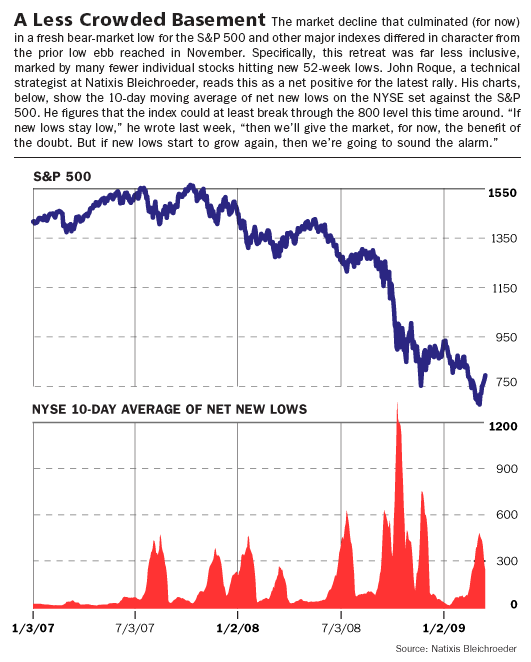
Divergence: 52 Week Lows and S&P500
>
Source:
Listening to the Echoes of 1938
MICHAEL SANTOLI
Barron’s MARCH 21, 2009
http://online.barrons.com/article/SB123758871198199971.html


Regulators Seize Two Large Credit Unions: U.S. Central and WesCorp
From National Credit Union Administration: NCUA Conserves U.S. Central and Western Corporate Credit Unions
The National Credit Union Administration Board today placed U.S. Central Federal Credit Union, Lenexa, Kansas, and Western Corporate (WesCorp) Federal Credit Union, San Dimas, California, into conservatorship to stabilize the corporate credit union system and resolve balance sheet issues. These actions are the latest NCUA efforts to assist the corporate credit union network under the Corporate Stabilization Plan.Assets of $57 billion? There are some losses coming ...
The two corporate credit unions were placed into conservatorship to protect retail credit union deposits and the interest of the National Credit Union Share Insurance Fund (NCUSIF), as well as to remove any impediments to the Agency’s ability to take appropriate mitigating actions that may be necessary. ...
Corporate credit unions do not serve consumers. They are chartered to provide products and services to the credit union system. These products and services will continue uninterrupted and there is no direct impact by NCUA’s actions on the 90 million credit union members nationwide. ...
U.S. Central has approximately $34 billion in assets and 26 retail corporate credit union members. WesCorp has $23 billion in assets and approximately 1,100 retail credit union members. The member accounts of both credit unions are guaranteed under provisions of the previously announced NCUA Share Guarantee Program, through December 31, 2010. The Program extends NCUSIF coverage to all funds held by the two corporate credit unions.
...
Additional mortgage and asset backed security analysis and assessment of the two credit unions by NCUA staff enabled NCUA to refine NCUSIF’s required reserve for potential loss. The findings indicated an overall estimated reserve level, previously announced by NCUA, had increased from $4.7 to $5.9 billion. The specific computation and the impact of the refined reserve level are addressed in NCUA Letter No: 09-CU-06, which NCUA issued and posted online today at http://www.ncua.gov/letters/letters.html.
NCUA is hosting a webcast Monday, March 23 at 2 p.m. to provide the credit union community with an update on the corporate credit union stabilization program.


A Lynch Mob!
David R. Kotok co-founded Cumberland Advisors in 1973 and has been its Chief Investment Officer since inception. He holds a B.S. in Economics from The Wharton School of the University of Pennsylvania, an M.S. in Organizational Dynamics from The School of Arts and Sciences at the University of Pennsylvania, and a Masters in Philosophy from the University of Pennsylvania. Mr. Kotok’s articles and financial market commentary have appeared in The New York Times, The Wall Street Journal, Barron’s, and other publications. He is a frequent contributor to CNBC programs. Mr. Kotok is also a member of the National Business Economics Issues Council (NBEIC), the National Association for Business Economics (NABE), the Philadelphia Council for Business Economics (PCBE), and the Philadelphia Financial Economists Group (PFEG).
~~~
A Lynch Mob!
March 21, 2009
“Let’s go hang ‘em.”
American history is replete with examples of lynch mobs taking control of a situation and inflicting injustice. In the end most lynch mobs have dealt harmful blows to society. Congressional action to punish AIG employees over the bonus issue is already seeding that outcome.
Members of the US House of Representatives who voted for this bill said they were reacting to the anger of their constituents. In failing to show leadership they have just undermined the entire structure designed to repair the financial system.
Specifically the House did the following:
1. They licensed the abrogation of contracts. Their message is simply that it makes no difference what rules we put into effect now; we can and will change them so you cannot depend on them. Global businesses take heed: Your previous judgment about the sanctity of US law has been rendered faulty by our political leadership.
2. They passed retroactive taxation. Their message is that, whatever you plan with regard to the federal tax code, do not assume consistency and do not build any reliability about your government into your decision making. We, in Congress, can reverse our laws and confiscate your results.
3. They made the tax punitive. A 90% tax on something is like taking all of it. The chairman (Rangel) of the House taxation committee actually admitted that by taxing the 90% he was leaving the remainder for the states. In other words, states are now encouraged to engage in the same form of behavior.
Sure citizens are outraged over the $165 million in bonus payments to AIG staff. But they should direct their outrage at the Congress and not threaten the employees or their families with personal injury. The Congress authorized these payments; Dodd, Geithner, and Obama Administration personnel admitted that. Remember, the law passed without giving anyone the chance to testify in public hearings and without allowing comment on the draft legislation. When the law originally went through the Congress, the House leadership suppressed amendments. This Barney Frank and Nancy Pelosi-led House is especially guilty of ignoring the rule of law. They are now guilty of encouraging the rule of lynch mob.
The result of this House action is already damaging. The federal regulator of Fannie Mae and Freddie Mac has shown the courage to ask that this law not be advanced in the Senate. We expect to hear more from those federal personalities who have the strength to speak up and oppose this House-approved proposal.
But depending on the Senate to soften the law or depending on the US Supreme Court to overturn it is a dangerous strategy. Some Congressmen admitted privately that they voted in favor because of constituent pressure, even though they were really opposed to the concept. They voted “yes” because they were relying on the Senate or the courts to say “no.”
Some damage is already done. Firms that were gearing up to participate in the federal program to be announced this coming week are considering withdrawal. They fear that any action which puts them into the federal assistance plan will subject them to the chance of retroactive punishment and taxation. The House has undermined the so-called public-private partnership designed to help restore financing of consumer items like automobiles and credit cards. We expect that the participation in the program to be announced this coming week will be tepid at best.
At Cumberland, we are advising institutional clients to take great care when engaging in any form of activity with the federal government. Simply put: a lynch mob can turn on you in a second and cannot be trusted. The risk is now very high.
Other firms that are already acting with TARP monies, or other federal monies for that matter, are seeking ways to deleverage and exit. In the entrepreneurial and risk-taking business and financial community the universal response to this act by Congress is outrage and distrust and disgust.
So far President Obama is silent on this lynch-mob approach. He has yet to declare himself against it.
Obama needs to be reminded of a parallel in history. A century ago a man named Leo Frank was lynched in Georgia for a murder he did not commit. Local politicians supported the lynch mob; those courageous politicians that opposed it were voted down. Frank was an innocent victim. His subsequent posthumous pardon did not undo the harm.
A century later a man named Barney Frank brags about the earmarks he obtained for his Congressional district (see his website). This modern Frank foments the modern-day version of a lynch mob. The House of Representatives and the Financial Services Committee under the leadership of Barney Frank have made the first day of spring, 2009 a sad day for America. They suppressed the rule of law; they chose the rule of the lynch mob; they are now going to have to live with that result.
When the citizens of America realize what the House has done, they may redirect the lynch mob against the Congress. That is coming next. As Yogi Berra said: “This ain’t over till it’s over.”
~~~
We fly to Europe in a few hours and will chair the Global Interdependence Center delegation at the Paris conference next week (see www.interdependence.org ). Meetings will include central bankers, global investors, and businessmen. Our private roundtable will now also address this House action and what it means for US policy and American markets. Current scheduling from Paris includes CNBC on Monday at 10 AM New York time and again on CNBC on Tuesday morning at 5 AM New York time.
David R. Kotok, Chairman and Chief Investment Officer, email: david.kotok@cumber.com


CRE: Cap Rate Expansion
Randyl Drummer at CoStar writes: Rising Cap Rates Add to Real Estate Investors' Worries. Here are some stats:
So for Class A office space, average actual cap rates have risen from 6.1% in Q4 2007 to 7.9% currently.In fourth-quarter 2007, 180 closed transactions of Class A office sales of more than $5 million were recorded, trading at an average actual cap rate of 6.1% nationally. By the last three months of 2008, the average cap rate spiked to 7.6% on just 80 transactions, including a jump of more than 100 basis points between the third and fourth quarters. With sales results for the quarter still being collected, CoStar had recorded 42 closed transactions at an average actual cap rate of 7.9% as of March 18. Investors closed 279 sales of Class A and B warehouse and distribution property in the fourth quarter of 2007 at an average cap rate of 7.1%. The number of transactions dropped sharply in fourth-quarter 2008, with the cap rate rising 100 bp. First-quarter 2009 is continuing to trend toward a sharp drop in transactions, with the cap rate edging up another 50 bp to a preliminary 8.6% as of March 18. In the apartment sector, a look at sales totaling $5 million or more shows that 629 Class A properties exchanged hands in fourth-quarter 2007 at an average actual cap rate of 5.9%. For the same period a year later, 355 transactions sold and the average cap rate rose 90 basis point to 6.8%, thanks to a 50-bp jump between the third and fourth quarters. Though deal volume appears to be again dropping sharply in the first quarter, the cap rate for closed transactions was holding steady at 6.8% in the quarter to date -- the only major property category to hold the line on cap rate expansion.
For Class A and B warehouse and distribution properties, cap rates have risen from 7.1% to 8.6% over the same period.
And for Class A apartments, cap rates have risen from 5.9% to 6.8%.
This is just another way of saying prices have fallen sharply. Most small investors buy Class B or C apartments, and I'd be curious about those cap rates.


Credit Unions, Bank Failures, and More
Regulators swoop and seize,
None "too big to fail".
by Soylent Green Is People
A couple of key points: these "corporate credit unions" don't serve the general public, and all "natural person" credit union money held at these corporate credit unions was guaranteed earlier this year.
From the WSJ: U.S. Seizes Key Cogs for Credit Unions
The affected institutions don't serve the general public. They provide critical financing, check clearing and other tasks for the retail institutions. These wholesale credit unions, known in industry parlance as corporate credit unions, are owned by their retail credit-union members.And from the NCUA January letter to Credit Unions:
Offering a temporary National Credit Union Share Insurance Fund (NCUSIF) guarantee of member shares in corporate credit unions. The guarantee will cover all shares, but does not include paid-in-capital and membership capital accounts, through December 31, 2010. This guarantee is the equivalent of full share insurance on member shares and will be extended beyond that date by the NCUA Board if necessary.So the natural person credit unions (the ones that serve the public) have had their money guaranteed.
Still the losses will be huge:
[Michael E. Fryzel, chairman of the National Credit Union Administration, the industry's federal regulator] said NCUA's latest estimate is that wholesale credit unions will eventually have to realize between $10 billion and $16 billion in losses on their holdings. The agency on Friday also raised its estimate for what these losses will cost its insurance fund, to $5.9 billion from the prior $4.7 billion estimate.
The federal government will announce as soon as Monday a three-pronged plan to rid the financial system of toxic assets, betting that investors will be attracted to the combination of discount prices and government assistance.


Investigating AIG
Everyone seems to be all abuzz about the Mike Taibbi takedown of AIG in Rolling Stone. Its a fun read — as is any piece that begins “we’re officially, royally fucked” — but there are a few other columns that do an excellent job contextualizing 1) How AIG got so heavily involved in CDOs and CDSs, and 2) What its going to take to clean up the ginormous mess they made.
If you are interested in learning the nitty gritty details about how AIG’s Financial Product division (AIGFP as it came to be known), then the place to start reading is the 3 part series WaPo did in the fall: Investigating AIG (full linkage below).
The clean up half of the story is best described by Carol Loomis in this month’s Fortune. (She makes it pretty clear that Liddy is not the bad guy).
Get crackin’ . . .
Investigating AIG: The Washington Post
Part I: The Beautiful Machine
Part 2: A Crack in the System
Part 3: Downgrades and DownfallsAIG’s rescue has a long way to go
Carol J. Loomis
Fortune DECEMBER 29, 2008: 10:46 AM ET
http://money.cnn.com/2008/12/23/news/companies/AIG_150bailout_Loomis.fortune/index.htmBehind Insurer’s Crisis, Blind Eye to a Web of Risk
GRETCHEN MORGENSON
The New York Times, September 27, 2008
http://www.nytimes.com/2008/09/28/business/28melt.html
The Big Takeover
MATT TAIBBI
Rolling Stone Mar 19, 2009 12:49 PM
http://www.rollingstone.com/politics/story/26793903/the_big_takeover


BF 19 & 20: FDIC Seizes Teambank, National Association, Paola, Kansas and Colorado National Bank, Colorado Springs, Colorado
From the FDIC: Herring Bank, Amarillo, Texas, Assumes All of the Deposits of Colorado National Bank, Colorado Springs, Colorado
Colorado National Bank, Colorado Springs, Colorado, was closed today by the Office of the Comptroller of the Currency, which appointed the Federal Deposit Insurance Corporation (FDIC) as receiver. To protect the depositors, the FDIC entered into a purchase and assumption agreement with Herring Bank, Amarillo, Texas, to assume all of the deposits of Colorado National.From the FDIC: Great Southern Bank, Springfield, Missouri, Assumes All of the Deposits of Teambank, National Association, Paola, Kansas
...
The FDIC estimates that the cost to the Deposit Insurance Fund will be $9 million. Herring Bank's acquisition of all the deposits was the "least costly" resolution for the FDIC's Deposit Insurance Fund compared to alternatives. Colorado National is the nineteenth FDIC-insured institution to fail in the nation this year and the first in the state. The last FDIC-insured institution closed in Colorado was BestBank, Boulder, on July 23, 1998.
Teambank, National Association, Paola, Kansas, was closed today by the Office of the Comptroller of the Currency, which appointed the Federal Deposit Insurance Corporation (FDIC) as receiver. To protect the depositors, the FDIC entered into a purchase and assumption agreement with Great Southern Bank, Springfield, Missouri, to assume all of the deposits of Teambank.That makes three today (the Corporate Credit Unions are different, but probably a bigger story).
...
The FDIC estimates that the cost to the Deposit Insurance Fund will be $98 million. Great Southern Bank's acquisition of all the deposits was the "least costly" resolution for the FDIC's Deposit Insurance Fund compared to alternatives. Teambank is the twentieth FDIC-insured institution to fail in the nation this year and the first in the state. The last FDIC-insured institution closed in Kansas was The Columbian Bank and Trust Company, Topeka, on August 22, 2008.
Teambank was affiliated with Colorado National Bank, Colorado Springs, which was also closed today by the Office of the Comptroller of the Currency. The FDIC entered into a separate transaction with Herring Bank, Amarillo, Texas, to assume the banking operations of Colorado National Bank.


Geithner's Toxic Asset Plan
The NY Times has some details ...
From Edmund L. Andrews, Eric Dash and Graham Bowley: Toxic Asset Plan Foresees Big Subsidies for Investors
The plan to be announced next week involves three separate approaches. In one, the Federal Deposit Insurance Corporation will set up special-purpose investment partnerships and lend about 85 percent of the money that those partnerships will need to buy up troubled assets that banks want to sell.More approaches doesn't make a better plan.
In the second, the Treasury will hire four or five investment management firms, matching the private money that each of the firms puts up on a dollar-for-dollar basis with government money.
In the third piece, the Treasury plans to expand lending through the Term Asset-Backed Secure Lending Facility, a joint venture with the Federal Reserve.
The FDIC plan involves almost no money down. The FDIC will provide a low interest non-recourse loan up to 85% of the value of the assets.
The remaining 15 percent will come from the government and the private investors. The Treasury would put up as much as 80 percent of that, while private investors would put up as little as 20 percent of the money ... Private investors, then, would be contributing as little as 3 percent of the equity, and the government as much as 97 percent.With almost no skin in the game, these investors can pay a higher than market price for the toxic assets (since there is little downside risk). This amounts to a direct subsidy from the taxpayers to the banks.
Oh well, I'm sure Geithner will provide details this time ...


Trading & Prenatal Hormone Levels

>
“Traders are succeeding not so much because they are rational, but because they have certain biological traits, including confidence, an appetite for risk, search persistence, and speed of reactions,” all of which are derived from prenatal exposure to testosterone.”
-John Coates, University of Cambridge neuroscientist and former trader
>
Here’s a fascinating study to get your weekend off in the right direction
“Coates examined the digit ratio of 44 male “high frequency” traders in London who buy and sell securities, sometimes in amounts greater than $1 billion, but hold their positions for minutes, sometimes only seconds. He found that traders with a longer ring finger than index finger made more money.
“We were on the trading floor taking samples for another experiment, and I read an article about digit ratio and sports,” says Coates. “I didn’t put too much stock in the measure, but we thought, ‘Why not look at fingers?’ We were shocked by the results.”
Exposure to high levels of testosterone before birth appears to make men more sensitive to the hormone as adults. In addition to playing a role in sexual functioning, testosterone has been associated with aggressive behavior and enhanced risk taking, and has been shown to predict performance in certain competitive sports.
Coates’ findings are consistent with a Harvard study of testosterone and financial risk taking that appeared in the November 2008 issue of Evolution and Human Behavior. Using an investment game, the Harvard researchers found that higher testosterone levels correlate with financial risk-taking behavior.
“Research on digit ratios in relation to a number of behavioral and psychological traits has exploded in the past 10 years, but many of the findings have not been as convincing [as Coates’],” Coren Apicella, lead author of the Harvard study, said in an e-mail. “Further study of biological markers and their relation to economic attributes will ultimately lead to a more comprehensive understanding of economic science.”
Fascinating stuff.
And all this time you thought it was hard work and free will . . .
>
Source:
Stock Market Success May Stem from Prenatal Hormone Levels
Scott P. Edwards
The Dana Foundation Brainwork, March 19, 2009
http://www.dana.org/news/brainwork/detail.aspx?id=19832


Escondido House: Over 80% Off Peak Price
From Zach Fox at the North County Times: From half a million to under $100K
This two-bedroom, two-bath house was built in 1979 and has 1,230 square feet of living space.
Click on photo for larger image in new window.Photo by Jamie Scott Lytle, North County Times Staff photographer
September 2005: $469,000
December 2008: $91,000 (foreclosure)
Why did someone pay $469,000 for this house in 2005? Amazing.
Divergence: 52 Week Lows and S&P500
>
Source:
Listening to the Echoes of 1938
MICHAEL SANTOLI
Barron’s MARCH 21, 2009
http://online.barrons.com/article/SB123758871198199971.html
Regulators Seize Two Large Credit Unions: U.S. Central and WesCorp
From National Credit Union Administration: NCUA Conserves U.S. Central and Western Corporate Credit Unions
The National Credit Union Administration Board today placed U.S. Central Federal Credit Union, Lenexa, Kansas, and Western Corporate (WesCorp) Federal Credit Union, San Dimas, California, into conservatorship to stabilize the corporate credit union system and resolve balance sheet issues. These actions are the latest NCUA efforts to assist the corporate credit union network under the Corporate Stabilization Plan.Assets of $57 billion? There are some losses coming ...
The two corporate credit unions were placed into conservatorship to protect retail credit union deposits and the interest of the National Credit Union Share Insurance Fund (NCUSIF), as well as to remove any impediments to the Agency’s ability to take appropriate mitigating actions that may be necessary. ...
Corporate credit unions do not serve consumers. They are chartered to provide products and services to the credit union system. These products and services will continue uninterrupted and there is no direct impact by NCUA’s actions on the 90 million credit union members nationwide. ...
U.S. Central has approximately $34 billion in assets and 26 retail corporate credit union members. WesCorp has $23 billion in assets and approximately 1,100 retail credit union members. The member accounts of both credit unions are guaranteed under provisions of the previously announced NCUA Share Guarantee Program, through December 31, 2010. The Program extends NCUSIF coverage to all funds held by the two corporate credit unions.
...
Additional mortgage and asset backed security analysis and assessment of the two credit unions by NCUA staff enabled NCUA to refine NCUSIF’s required reserve for potential loss. The findings indicated an overall estimated reserve level, previously announced by NCUA, had increased from $4.7 to $5.9 billion. The specific computation and the impact of the refined reserve level are addressed in NCUA Letter No: 09-CU-06, which NCUA issued and posted online today at http://www.ncua.gov/letters/letters.html.
NCUA is hosting a webcast Monday, March 23 at 2 p.m. to provide the credit union community with an update on the corporate credit union stabilization program.
A Lynch Mob!
David R. Kotok co-founded Cumberland Advisors in 1973 and has been its Chief Investment Officer since inception. He holds a B.S. in Economics from The Wharton School of the University of Pennsylvania, an M.S. in Organizational Dynamics from The School of Arts and Sciences at the University of Pennsylvania, and a Masters in Philosophy from the University of Pennsylvania. Mr. Kotok’s articles and financial market commentary have appeared in The New York Times, The Wall Street Journal, Barron’s, and other publications. He is a frequent contributor to CNBC programs. Mr. Kotok is also a member of the National Business Economics Issues Council (NBEIC), the National Association for Business Economics (NABE), the Philadelphia Council for Business Economics (PCBE), and the Philadelphia Financial Economists Group (PFEG).
~~~
A Lynch Mob!
March 21, 2009
“Let’s go hang ‘em.”
American history is replete with examples of lynch mobs taking control of a situation and inflicting injustice. In the end most lynch mobs have dealt harmful blows to society. Congressional action to punish AIG employees over the bonus issue is already seeding that outcome.
Members of the US House of Representatives who voted for this bill said they were reacting to the anger of their constituents. In failing to show leadership they have just undermined the entire structure designed to repair the financial system.
Specifically the House did the following:
1. They licensed the abrogation of contracts. Their message is simply that it makes no difference what rules we put into effect now; we can and will change them so you cannot depend on them. Global businesses take heed: Your previous judgment about the sanctity of US law has been rendered faulty by our political leadership.
2. They passed retroactive taxation. Their message is that, whatever you plan with regard to the federal tax code, do not assume consistency and do not build any reliability about your government into your decision making. We, in Congress, can reverse our laws and confiscate your results.
3. They made the tax punitive. A 90% tax on something is like taking all of it. The chairman (Rangel) of the House taxation committee actually admitted that by taxing the 90% he was leaving the remainder for the states. In other words, states are now encouraged to engage in the same form of behavior.
Sure citizens are outraged over the $165 million in bonus payments to AIG staff. But they should direct their outrage at the Congress and not threaten the employees or their families with personal injury. The Congress authorized these payments; Dodd, Geithner, and Obama Administration personnel admitted that. Remember, the law passed without giving anyone the chance to testify in public hearings and without allowing comment on the draft legislation. When the law originally went through the Congress, the House leadership suppressed amendments. This Barney Frank and Nancy Pelosi-led House is especially guilty of ignoring the rule of law. They are now guilty of encouraging the rule of lynch mob.
The result of this House action is already damaging. The federal regulator of Fannie Mae and Freddie Mac has shown the courage to ask that this law not be advanced in the Senate. We expect to hear more from those federal personalities who have the strength to speak up and oppose this House-approved proposal.
But depending on the Senate to soften the law or depending on the US Supreme Court to overturn it is a dangerous strategy. Some Congressmen admitted privately that they voted in favor because of constituent pressure, even though they were really opposed to the concept. They voted “yes” because they were relying on the Senate or the courts to say “no.”
Some damage is already done. Firms that were gearing up to participate in the federal program to be announced this coming week are considering withdrawal. They fear that any action which puts them into the federal assistance plan will subject them to the chance of retroactive punishment and taxation. The House has undermined the so-called public-private partnership designed to help restore financing of consumer items like automobiles and credit cards. We expect that the participation in the program to be announced this coming week will be tepid at best.
At Cumberland, we are advising institutional clients to take great care when engaging in any form of activity with the federal government. Simply put: a lynch mob can turn on you in a second and cannot be trusted. The risk is now very high.
Other firms that are already acting with TARP monies, or other federal monies for that matter, are seeking ways to deleverage and exit. In the entrepreneurial and risk-taking business and financial community the universal response to this act by Congress is outrage and distrust and disgust.
So far President Obama is silent on this lynch-mob approach. He has yet to declare himself against it.
Obama needs to be reminded of a parallel in history. A century ago a man named Leo Frank was lynched in Georgia for a murder he did not commit. Local politicians supported the lynch mob; those courageous politicians that opposed it were voted down. Frank was an innocent victim. His subsequent posthumous pardon did not undo the harm.
A century later a man named Barney Frank brags about the earmarks he obtained for his Congressional district (see his website). This modern Frank foments the modern-day version of a lynch mob. The House of Representatives and the Financial Services Committee under the leadership of Barney Frank have made the first day of spring, 2009 a sad day for America. They suppressed the rule of law; they chose the rule of the lynch mob; they are now going to have to live with that result.
When the citizens of America realize what the House has done, they may redirect the lynch mob against the Congress. That is coming next. As Yogi Berra said: “This ain’t over till it’s over.”
~~~
We fly to Europe in a few hours and will chair the Global Interdependence Center delegation at the Paris conference next week (see www.interdependence.org ). Meetings will include central bankers, global investors, and businessmen. Our private roundtable will now also address this House action and what it means for US policy and American markets. Current scheduling from Paris includes CNBC on Monday at 10 AM New York time and again on CNBC on Tuesday morning at 5 AM New York time.
David R. Kotok, Chairman and Chief Investment Officer, email: david.kotok@cumber.com
CRE: Cap Rate Expansion
Randyl Drummer at CoStar writes: Rising Cap Rates Add to Real Estate Investors' Worries. Here are some stats:
So for Class A office space, average actual cap rates have risen from 6.1% in Q4 2007 to 7.9% currently.In fourth-quarter 2007, 180 closed transactions of Class A office sales of more than $5 million were recorded, trading at an average actual cap rate of 6.1% nationally. By the last three months of 2008, the average cap rate spiked to 7.6% on just 80 transactions, including a jump of more than 100 basis points between the third and fourth quarters. With sales results for the quarter still being collected, CoStar had recorded 42 closed transactions at an average actual cap rate of 7.9% as of March 18. Investors closed 279 sales of Class A and B warehouse and distribution property in the fourth quarter of 2007 at an average cap rate of 7.1%. The number of transactions dropped sharply in fourth-quarter 2008, with the cap rate rising 100 bp. First-quarter 2009 is continuing to trend toward a sharp drop in transactions, with the cap rate edging up another 50 bp to a preliminary 8.6% as of March 18. In the apartment sector, a look at sales totaling $5 million or more shows that 629 Class A properties exchanged hands in fourth-quarter 2007 at an average actual cap rate of 5.9%. For the same period a year later, 355 transactions sold and the average cap rate rose 90 basis point to 6.8%, thanks to a 50-bp jump between the third and fourth quarters. Though deal volume appears to be again dropping sharply in the first quarter, the cap rate for closed transactions was holding steady at 6.8% in the quarter to date -- the only major property category to hold the line on cap rate expansion.
For Class A and B warehouse and distribution properties, cap rates have risen from 7.1% to 8.6% over the same period.
And for Class A apartments, cap rates have risen from 5.9% to 6.8%.
This is just another way of saying prices have fallen sharply. Most small investors buy Class B or C apartments, and I'd be curious about those cap rates.
Credit Unions, Bank Failures, and More
Regulators swoop and seize,
None "too big to fail".
by Soylent Green Is People
A couple of key points: these "corporate credit unions" don't serve the general public, and all "natural person" credit union money held at these corporate credit unions was guaranteed earlier this year.
From the WSJ: U.S. Seizes Key Cogs for Credit Unions
The affected institutions don't serve the general public. They provide critical financing, check clearing and other tasks for the retail institutions. These wholesale credit unions, known in industry parlance as corporate credit unions, are owned by their retail credit-union members.And from the NCUA January letter to Credit Unions:
Offering a temporary National Credit Union Share Insurance Fund (NCUSIF) guarantee of member shares in corporate credit unions. The guarantee will cover all shares, but does not include paid-in-capital and membership capital accounts, through December 31, 2010. This guarantee is the equivalent of full share insurance on member shares and will be extended beyond that date by the NCUA Board if necessary.So the natural person credit unions (the ones that serve the public) have had their money guaranteed.
Still the losses will be huge:
[Michael E. Fryzel, chairman of the National Credit Union Administration, the industry's federal regulator] said NCUA's latest estimate is that wholesale credit unions will eventually have to realize between $10 billion and $16 billion in losses on their holdings. The agency on Friday also raised its estimate for what these losses will cost its insurance fund, to $5.9 billion from the prior $4.7 billion estimate.
The federal government will announce as soon as Monday a three-pronged plan to rid the financial system of toxic assets, betting that investors will be attracted to the combination of discount prices and government assistance.
Investigating AIG
Everyone seems to be all abuzz about the Mike Taibbi takedown of AIG in Rolling Stone. Its a fun read — as is any piece that begins “we’re officially, royally fucked” — but there are a few other columns that do an excellent job contextualizing 1) How AIG got so heavily involved in CDOs and CDSs, and 2) What its going to take to clean up the ginormous mess they made.
If you are interested in learning the nitty gritty details about how AIG’s Financial Product division (AIGFP as it came to be known), then the place to start reading is the 3 part series WaPo did in the fall: Investigating AIG (full linkage below).
The clean up half of the story is best described by Carol Loomis in this month’s Fortune. (She makes it pretty clear that Liddy is not the bad guy).
Get crackin’ . . .
Investigating AIG: The Washington Post
Part I: The Beautiful Machine
Part 2: A Crack in the System
Part 3: Downgrades and DownfallsAIG’s rescue has a long way to go
Carol J. Loomis
Fortune DECEMBER 29, 2008: 10:46 AM ET
http://money.cnn.com/2008/12/23/news/companies/AIG_150bailout_Loomis.fortune/index.htmBehind Insurer’s Crisis, Blind Eye to a Web of Risk
GRETCHEN MORGENSON
The New York Times, September 27, 2008
http://www.nytimes.com/2008/09/28/business/28melt.html
The Big Takeover
MATT TAIBBI
Rolling Stone Mar 19, 2009 12:49 PM
http://www.rollingstone.com/politics/story/26793903/the_big_takeover
BF 19 & 20: FDIC Seizes Teambank, National Association, Paola, Kansas and Colorado National Bank, Colorado Springs, Colorado
From the FDIC: Herring Bank, Amarillo, Texas, Assumes All of the Deposits of Colorado National Bank, Colorado Springs, Colorado
Colorado National Bank, Colorado Springs, Colorado, was closed today by the Office of the Comptroller of the Currency, which appointed the Federal Deposit Insurance Corporation (FDIC) as receiver. To protect the depositors, the FDIC entered into a purchase and assumption agreement with Herring Bank, Amarillo, Texas, to assume all of the deposits of Colorado National.From the FDIC: Great Southern Bank, Springfield, Missouri, Assumes All of the Deposits of Teambank, National Association, Paola, Kansas
...
The FDIC estimates that the cost to the Deposit Insurance Fund will be $9 million. Herring Bank's acquisition of all the deposits was the "least costly" resolution for the FDIC's Deposit Insurance Fund compared to alternatives. Colorado National is the nineteenth FDIC-insured institution to fail in the nation this year and the first in the state. The last FDIC-insured institution closed in Colorado was BestBank, Boulder, on July 23, 1998.
Teambank, National Association, Paola, Kansas, was closed today by the Office of the Comptroller of the Currency, which appointed the Federal Deposit Insurance Corporation (FDIC) as receiver. To protect the depositors, the FDIC entered into a purchase and assumption agreement with Great Southern Bank, Springfield, Missouri, to assume all of the deposits of Teambank.That makes three today (the Corporate Credit Unions are different, but probably a bigger story).
...
The FDIC estimates that the cost to the Deposit Insurance Fund will be $98 million. Great Southern Bank's acquisition of all the deposits was the "least costly" resolution for the FDIC's Deposit Insurance Fund compared to alternatives. Teambank is the twentieth FDIC-insured institution to fail in the nation this year and the first in the state. The last FDIC-insured institution closed in Kansas was The Columbian Bank and Trust Company, Topeka, on August 22, 2008.
Teambank was affiliated with Colorado National Bank, Colorado Springs, which was also closed today by the Office of the Comptroller of the Currency. The FDIC entered into a separate transaction with Herring Bank, Amarillo, Texas, to assume the banking operations of Colorado National Bank.
Geithner's Toxic Asset Plan
The NY Times has some details ...
From Edmund L. Andrews, Eric Dash and Graham Bowley: Toxic Asset Plan Foresees Big Subsidies for Investors
The plan to be announced next week involves three separate approaches. In one, the Federal Deposit Insurance Corporation will set up special-purpose investment partnerships and lend about 85 percent of the money that those partnerships will need to buy up troubled assets that banks want to sell.More approaches doesn't make a better plan.
In the second, the Treasury will hire four or five investment management firms, matching the private money that each of the firms puts up on a dollar-for-dollar basis with government money.
In the third piece, the Treasury plans to expand lending through the Term Asset-Backed Secure Lending Facility, a joint venture with the Federal Reserve.
The FDIC plan involves almost no money down. The FDIC will provide a low interest non-recourse loan up to 85% of the value of the assets.
The remaining 15 percent will come from the government and the private investors. The Treasury would put up as much as 80 percent of that, while private investors would put up as little as 20 percent of the money ... Private investors, then, would be contributing as little as 3 percent of the equity, and the government as much as 97 percent.With almost no skin in the game, these investors can pay a higher than market price for the toxic assets (since there is little downside risk). This amounts to a direct subsidy from the taxpayers to the banks.
Oh well, I'm sure Geithner will provide details this time ...
Trading & Prenatal Hormone Levels
>
“Traders are succeeding not so much because they are rational, but because they have certain biological traits, including confidence, an appetite for risk, search persistence, and speed of reactions,” all of which are derived from prenatal exposure to testosterone.”
-John Coates, University of Cambridge neuroscientist and former trader
>
Here’s a fascinating study to get your weekend off in the right direction
“Coates examined the digit ratio of 44 male “high frequency” traders in London who buy and sell securities, sometimes in amounts greater than $1 billion, but hold their positions for minutes, sometimes only seconds. He found that traders with a longer ring finger than index finger made more money.
“We were on the trading floor taking samples for another experiment, and I read an article about digit ratio and sports,” says Coates. “I didn’t put too much stock in the measure, but we thought, ‘Why not look at fingers?’ We were shocked by the results.”
Exposure to high levels of testosterone before birth appears to make men more sensitive to the hormone as adults. In addition to playing a role in sexual functioning, testosterone has been associated with aggressive behavior and enhanced risk taking, and has been shown to predict performance in certain competitive sports.
Coates’ findings are consistent with a Harvard study of testosterone and financial risk taking that appeared in the November 2008 issue of Evolution and Human Behavior. Using an investment game, the Harvard researchers found that higher testosterone levels correlate with financial risk-taking behavior.
“Research on digit ratios in relation to a number of behavioral and psychological traits has exploded in the past 10 years, but many of the findings have not been as convincing [as Coates’],” Coren Apicella, lead author of the Harvard study, said in an e-mail. “Further study of biological markers and their relation to economic attributes will ultimately lead to a more comprehensive understanding of economic science.”
Fascinating stuff.
And all this time you thought it was hard work and free will . . .
>
Source:
Stock Market Success May Stem from Prenatal Hormone Levels
Scott P. Edwards
The Dana Foundation Brainwork, March 19, 2009
http://www.dana.org/news/brainwork/detail.aspx?id=19832

No comments:
Post a Comment